REVIEW · BUDAPEST
Cinematic Virtual Reality City Tour in a Russian Jeep
Book on Viator →Operated by BUDTOURS · Bookable on Viator
Time travel rides shotgun in Budapest. This cinematic VR city tour lets you point a headset at famous landmarks and watch their stories unfold as 2D videos while you cruise around in a Russian Jeep.
I like the way the route hits major sights fast, with VR moments at each stop instead of long museum hours. I also like that you get hotel pickup and drop-off plus an English guide in person, so you can ask questions in real time.
One consideration: the on-foot time at each landmark is short, so it is great for first impressions, but not ideal if you want to linger for deep, slow exploring.
In This Review
- Key highlights you will care about
- A Two-Hour Budapest VR Ride in a Russian Jeep
- Price Check: How $3 Can Be a Real Value (and What It Costs You Extra)
- How the VR Headset Works at Each Landmark (Practical Tips)
- Castle Hill Stops: Castle Garden Bazaar, Fisherman’s Bastion Views, and Matthias Church
- Castle Garden (Buda Castle complex area)
- Fisherman’s Bastion (including the view factor)
- Matthias Church (entry not included)
- Danube Icons: Széchenyi Chain Bridge, Parliament Passing Views, and Old Erzsébet Bridge VR
- Széchenyi Chain Bridge lion statue area
- Hungarian Parliament Building (pass by)
- Old Erzsébet Bridge VR time travel
- Andrássy Avenue to Heroes’ Square: Opera Facades, House of Terror passing, and Millennium Monument
- Andrássy Avenue (UNESCO boulevard feel)
- Hungarian State Opera House (pass by)
- House of Terror (passing)
- Heroes’ Square
- Central Squares and Famous Cafés: Blaha Lujza, Ferenciek Square, and New York Palace
- Blaha Lujza tér
- Ferenciek Square (with Paris Garden and Klotild Palace)
- New York Palace café time potential
- Who This Tour Fits Best (and Who Might Be Happier Skipping It)
- Should You Book This Cinematic VR Jeep Tour?
- FAQ
- How long is the Cinematic VR City Tour in Budapest?
- Is hotel pickup and drop-off included?
- What VR equipment is provided?
- Are drinks included?
- Do I need to pay admission for any stops?
- Is this tour private?
- Is the tour suitable for everyone?
- Can I cancel for free?
Key highlights you will care about
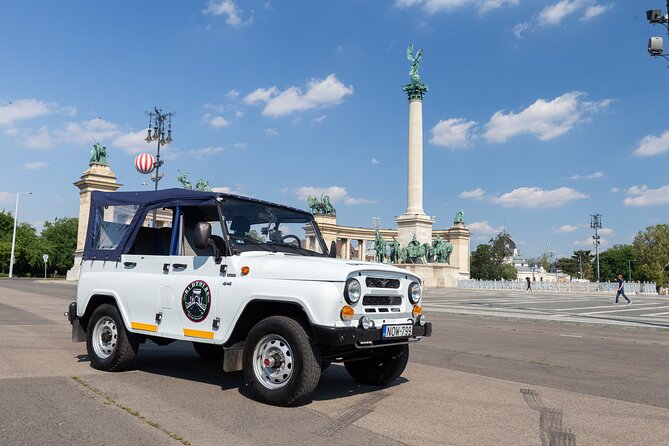
- Russian Jeep + private transport: quick hops between Buda and Pest with less transit stress
- Headset at landmarks: you watch cinematic 2D videos while standing at the real locations
- English guide included: history is explained on the ground, not only through audio
- Most stops are free to view: only a couple of paid-entry items may pop up
- Winter comfort included: bottled water year-round, hot tea in winter
- Not for everyone: the VR headset is not recommended if you have epilepsy
A Two-Hour Budapest VR Ride in a Russian Jeep
Budapest can feel like a lot at once: hills, rivers, big buildings, and postcard views stacked on top of each other. This tour simplifies it. You ride in a Russian Jeep style vehicle (one description calls it UAZ-like), and you stop just long enough to anchor the scene in the real world before the headset brings the past back to your eyes.
You are not just sightseeing. You are doing a guided timeline. At each major landmark, the VR kit is part of the activity, and you watch cinematic 2D videos tied to that specific spot. Add an in-person English guide and a mix of historical audio support, and you get the best combo: stories you understand plus visuals you do not have to imagine.
The tour is private, so it is only your group. That matters because headset time can be awkward in a crowded group, and it is easier to keep the pace relaxed. You also get a mobile ticket, and the pickup/drop-off is handled, which cuts down on figuring out meeting points when Budapest streets start to blur.
You can also read our reviews of more city tours in Budapest

Price Check: How $3 Can Be a Real Value (and What It Costs You Extra)
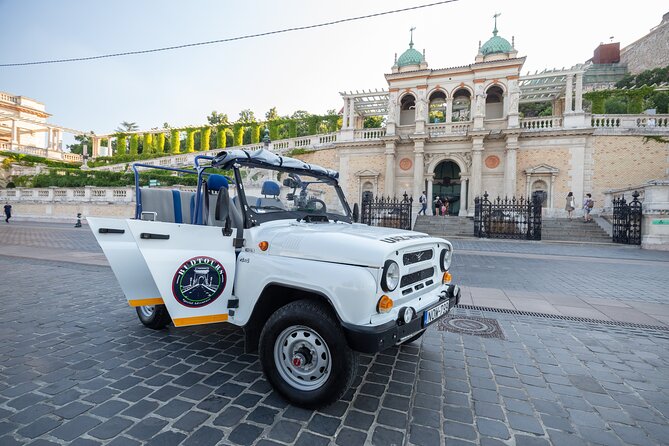
At $3, this is priced like a budget snack, not a full production. That is why I think it can be such good value for many visitors: you get hotel pickup/drop-off, private transport, VR gear, and an English guide, all bundled into a short circuit.
The catch is not the price. The catch is that some parts are not covered entry-wise. Matthias Church is listed as not included. Also, at Fisherman’s Bastion, the upper level needs an admission fee, while other parts can be viewed without paying extra.
So, what you are really “buying” for $3 is:
- a guided loop of top sights
- VR video storytelling at those locations
- transportation + headset + a guide
- and a chance to decide later which paid sites are worth your time
If you are the type who likes a quick orientation and then chooses where to return, this structure fits well. If you want everything fully included, you will want to plan for at least one likely paid item.
How the VR Headset Works at Each Landmark (Practical Tips)
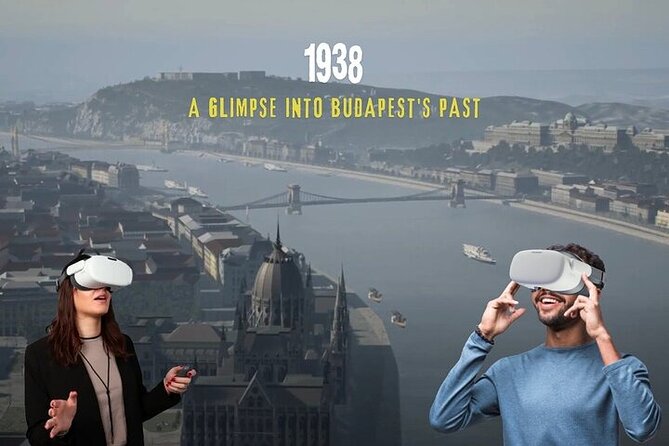
The tour is built around a simple formula: see the landmark, then put on the VR headset for cinematic scenes that connect to what you are standing in front of. Because the videos are described as 2D cinematic, you should expect a film-like experience rather than full motion freestyle walking.
Here is how to make that time easier:
- Give yourself a moment to focus before putting the headset on. Headsets are always a little fiddly at first.
- Wear something comfortable. You will be in and out quickly at stops, and you do not want to rush while tightening straps.
- If you wear glasses, you might find it helpful to test the headset fit early in the tour rather than at the first stop.
- Build in patience. At the popular sights, you are doing VR while people are around you, so a little calm helps.
Safety note: the tour is not recommended for travelers suffering from epilepsy, because of the VR experience. If that applies, skip this one.
Castle Hill Stops: Castle Garden Bazaar, Fisherman’s Bastion Views, and Matthias Church
Castle Hill is where Budapest goes from pretty to theatrical. This tour puts you in the Castle Quarter area and uses VR to tie landmarks to their past while you still get real views outside.
Castle Garden (Buda Castle complex area)
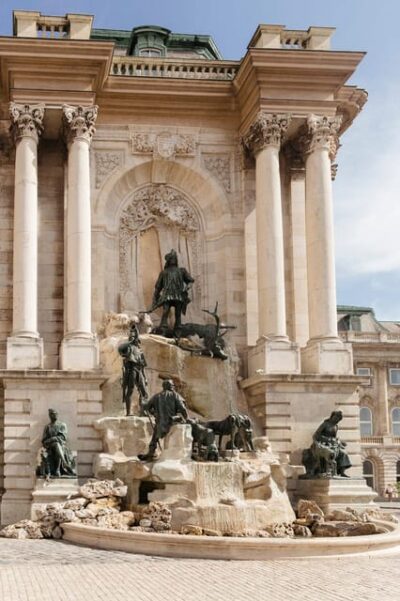
You spend about 3 minutes here, and entry is free. Castle Garden Bazaar is described as a Neo-Renaissance beauty inside the wider Buda Castle complex. Even if you barely scratch the surface on this quick stop, it is a good “set piece” location for the tour’s style: ornate architecture in a tight timeframe.
VR angle: you are using the stop as a context anchor. When you later look back at photos, this kind of early scene helps your brain connect what you saw later.




Fisherman’s Bastion (including the view factor)
You get about 15 minutes here. The views are the main event, and the real surprise is the backstory. Even though it looks ancient, Fisherman’s Bastion was built in the early 20th century to celebrate Hungary’s 1000th birthday. It is described like a birthday cake of a building, and honestly, that comparison sticks for a reason.
Admission detail: only the upper level requires a fee. You can still enjoy plenty from the free areas, so if you want to control spending, you can plan your route accordingly. If the view level matters most to you, budget for that extra admission.
VR angle: the headset fits well here because the place is made for looking outward, and the VR timeline turns that outward moment into a story.
Matthias Church (entry not included)
You get about 15 minutes at Matthias Church, and the interior is the payoff. The church is described as one of Europe’s most unique, with an interior mixing oriental flair and romantic historicism, topped with Neo-Gothic design cues.
But here is the practical part: Matthias Church entry is not included, so you may need to pay on-site if you want inside access. If your priority is only the exterior and the VR storytelling, you might be able to keep costs down—yet if you care about interior details, this is one stop worth paying for.
Danube Icons: Széchenyi Chain Bridge, Parliament Passing Views, and Old Erzsébet Bridge VR
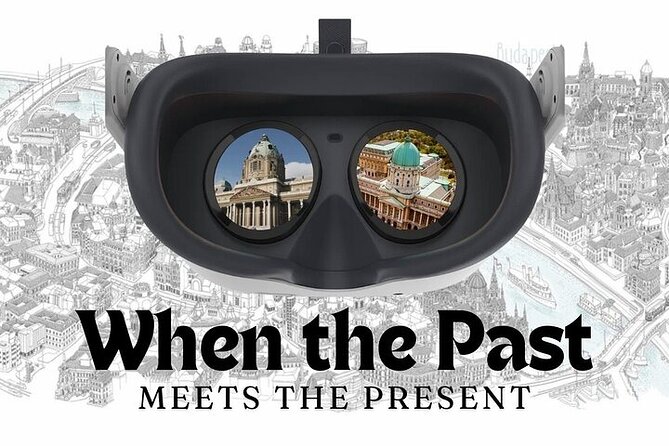
The Danube is Budapest’s main character, and this tour treats it that way with multiple bridge and riverfront references. Even when you do not go inside buildings, the VR scenes help turn skyline photos into something with a timeline.
Széchenyi Chain Bridge lion statue area
You spend about 5 minutes and admission is free. The bridge is described as the grand link between Buda and Pest, named after Count István Széchenyi. This is where your VR segment is meant to show the bridge’s dramatic history while you stand near the real structure.
Practical tip: keep this stop as a quick snapshot-and-headset moment. The bridge area is visually loud, so this is not where you want to slow-walk and then scramble for headset time.
Hungarian Parliament Building (pass by)
You are not paying entry here, and the tour lists it as a pass-by moment along the Danube near Kossuth Square. The Parliament is described as neo-Gothic, Hungary’s largest building since it was built, and a symbol of Hungarian pride.
VR angle: the headset is used to reveal the building’s past in a more entertaining, film-like way than reading plaques. This works well if you want context without committing to a formal interior visit.
Old Erzsébet Bridge VR time travel
This is another VR-powered highlight, and it comes with specific historical numbers that make it feel grounded:
- the old Erzsébet Bridge served from 1903 to 1945
- built between 1898 and 1903
- held a world record for 25 years in its category
- held the Danube record-holder status for 70 years
You are essentially getting a mini history lesson inside the headset, with enough concrete dates to make it more than vague nostalgia.
Andrássy Avenue to Heroes’ Square: Opera Facades, House of Terror passing, and Millennium Monument
This stretch is Budapest’s formal grand boulevard energy. In short time, you see the kind of architecture people photograph for a reason: strong lines, impressive façades, and a sense of ceremony in the streetscape.
Andrássy Avenue (UNESCO boulevard feel)
You get about 15 minutes here, and it is free. The avenue is described as Neo-Renaissance and UNESCO World Heritage, lined with upscale boutiques, cozy cafés, and elegant restaurants.
This is a good stop for “walking your eyes.” Even without museum tickets, the streets themselves do the work: you get the scale of the buildings and the street rhythm.
Hungarian State Opera House (pass by)
You have about 5 minutes and entry is not included. From the exterior, the Opera House is described as neo-Renaissance with a symmetrical design and statues of composers on the façade. Inside details are described too: marble sphinxes, frescoes, and gold accents.
VR angle: if you are not entering, the headset helps you still experience the Opera House’s golden age story. That is valuable because the building is easy to admire from outside, but harder to appreciate fully without time inside.
House of Terror (passing)
There is also a pass-by of the House of Terror at 60 Andrássy Avenue. This is a museum and memorial tied to Hungary’s struggles under fascist and communist regimes, focused on suffering and imprisonment.
If you prefer lighter storytelling, keep in mind this is one of the more serious stops on the route. It may not be the “fun photo” moment, but it is historically important.
Heroes’ Square
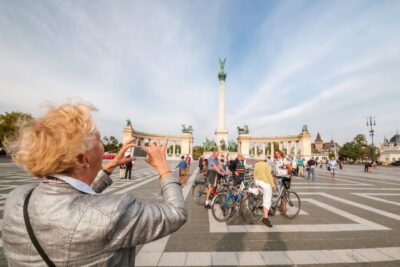
You spend about 15 minutes at Hősök tere. This is where Budapest goes statue-heavy with the Millennium Monument. You get important Hungarian leaders plus the Seven Chieftains of the Magyars, and the square sits at the end of Andrássy Avenue near City Park.
VR angle: even when you do not pay entry anywhere, the headset can help make sense of what you are seeing, especially if statues are usually just a background for you.
Central Squares and Famous Cafés: Blaha Lujza, Ferenciek Square, and New York Palace
This part of the route brings you back into modern street life, where history is layered over daily movement. You do quick stops, but the VR storytelling turns those quick stops into a clearer mental map.
Blaha Lujza tér
You spend about 5 minutes at Blaha Lujza Square, a busy spot named after actress Blaha Lujza. The tour notes that it used to be home to the National Theatre, and today it connects into the present with Corvin Plaza nearby.
VR angle: the headset brings you back to the era when the National Theatre stood there. Short time, strong payoff—this is a “blink and you get it” moment.
Ferenciek Square (with Paris Garden and Klotild Palace)
You get another stop focused on a compact historic area. Ferenciek Square is described as a blend of history and elegance, with Paris Garden (noted as a charming hotel café) and Klotild Palace, once tied to the royal family.
VR angle: it is another time-translation moment. The headset is used to show how the square used to look in its former glory, so your real-world photos later feel more meaningful.
New York Palace café time potential
There is also a mention of New York Palace as a well-known café option for coffee and tea, noted as having been chosen as café of the year several times. This looks like a suggested break point rather than a required stop inside the tour.
I would treat this as an “if you need a sit-down” option. The tour already includes bottled water (and hot tea in winter), but café time can still be part of the fun.
Who This Tour Fits Best (and Who Might Be Happier Skipping It)
This experience is best for you if:
- you want a fast, structured overview of Budapest’s top sights
- you like an unusual format (headset plus cinematic storytelling)
- you are traveling with family and prefer a private group pace
- you appreciate value pricing and included logistics like pickup, transport, and a guide
- you might enjoy the nostalgia factor of a Russian Jeep (one write-up even called it UAZ and tied it to a childhood memory)
One personal-feeling note from the route descriptions: the driver can be funny and attentive, and the car ride itself can feel like part of the experience. One example names a driver called Zsombor and praises him for answering questions and adding fun to the ride, including scenic routing that can pass via Gellért Hill.
You might want a different plan if:
- you want hours in a single church or museum (this tour keeps stops short)
- you are sensitive to VR devices (epilepsy is the stated no-go)
Should You Book This Cinematic VR Jeep Tour?
I think this is an easy recommendation if your goal is to get oriented, see the big icons across Buda and Pest, and learn the stories in a way that sticks. The low price makes it especially appealing, and the included package (pickup, private transport, VR gear, English guide, water and hot tea in winter) is where the value really shows.
Before you book, just do two quick reality checks:
- Plan for possible paid entries at Matthias Church and the Fisherman’s Bastion upper level if you want the highest viewpoint.
- Make sure VR fits you comfortably, especially if you have any medical concerns related to epilepsy.
If that works for you, you will likely end your day with more than photos. You will have a clearer mental timeline of Budapest, delivered in a format that is simple, fast, and genuinely different.
FAQ
How long is the Cinematic VR City Tour in Budapest?
The tour lasts about 2 hours.
Is hotel pickup and drop-off included?
Yes, hotel pickup and drop-off are included.
What VR equipment is provided?
Virtual reality gear/headset is provided as part of the tour.
Are drinks included?
Yes. The tour includes bottled water, and in winter time it also includes hot tea.
Do I need to pay admission for any stops?
Matthias Church entry is not included. At Fisherman’s Bastion, only the upper level requires an admission fee.
Is this tour private?
Yes. It is a private tour/activity, and only your group participates.
Is the tour suitable for everyone?
Service animals are allowed. The tour is most suitable for most travelers, but it is not recommended for travelers suffering from epilepsy.
Can I cancel for free?
Yes. Free cancellation is allowed up to 24 hours in advance for a full refund. If you cancel less than 24 hours before the start time, the amount paid is not refunded.