Budapest’s Art Nouveau comes alive fast. I love how this private, guided route turns building details into clear stories, and I love the coffee stop in an Art Nouveau setting. One consideration: you should double-check your exact pickup details so the meeting point doesn’t become a last-minute scramble.
You’ll spend about 4 hours walking and stepping inside carefully chosen stops, with hotel (or port) pickup and drop-off included. Guides can be superb at connecting architecture to Hungarian culture—names like Szőke Zsuzsanna, Suzy, and Bogata show up in the sort of feedback that matters: fast facts, real passion, and good pacing.
The biggest “watch this” item is the vibe of a private tour: if you like a strict, never-changing schedule, you may want to set that expectation with your guide at the start.
In This Review
- Key reasons this tour works in real life
- Budapest Secession vs. “just Art Nouveau”: what you’ll learn fast
- A 4-hour plan that mixes walking, interiors, and smart pauses
- The first iconic stop: where Art Nouveau’s “big idea” shows up
- Parisian Passage Café: coffee, passages, and the feeling of design
- Liszt Academy: mosaics, mosaics, mosaics (plus national pride)
- Váci Street fashion palaces: learning to spot Secession on the go
- Torok-Bankhaz and Postatakarek: the transition from Art Nouveau to Art Deco
- House of Hungarian Art Nouveau: Secession through a national lens
- Zoo-area architecture and the Museum of Applied Arts facade stop
- Price, private group value, and how to gauge $243.53 worth it
- Logistics that matter: pickup, weather, and not getting turned around
- Who should book this Art Nouveau Private Tour
- Should you book Private Art Nouveau Tour Budapest?
- FAQ
- How long is the Private Art Nouveau Tour Budapest?
- What is the group size for this private tour?
- Is hotel or port pickup included?
- What language is the tour offered in?
- Is the tour ticket digital?
- Is coffee included?
- Do I need to pay for admission tickets at the stops?
- Are public transportation tickets included?
- Does the tour run in bad weather?
- Can I cancel for a full refund?
- Are service animals allowed?
Key reasons this tour works in real life
Private guide attention for a 4-hour deep look. You get one group, one pace, and help spotting the details you’d otherwise walk past.
Free entry at most listed stops. The tour marks multiple admissions as ticket free, so you’re not constantly adding costs.
Art Nouveau through recognizable Budapest landmarks. You’ll see more than façades, including interior time at key spots.
Coffee in a true Art Nouveau setting. Not a random café stop—this is part of the architecture story.
Pickup and drop-off save time. It’s easier to get your bearings without juggling trams or metro lines.
Flexible walking plans when needed. At least one guide approach includes adapting transport so people can keep up.
Budapest Secession vs. “just Art Nouveau”: what you’ll learn fast
Budapest’s Art Nouveau era isn’t only about pretty curves. On this tour, you’ll connect the style to ideas about national identity—Hungarians wanted architecture that felt local, not copied. That’s why the tour repeatedly focuses on the Hungarian branch of Secession and the “national style,” rather than treating Art Nouveau as a single look.
You’ll also notice how the city’s pre-war architecture shifts over time. The route is built to show a transition between major styles, so you’re not only looking at one moment in design history. You’ll leave with a clearer sense of what makes Hungarian Secession feel different: ornament tied to symbols, interiors that read like statements, and buildings that look “designed,” not just decorated.
If you like photography, this kind of context helps. You’ll know what to look for before you lift your camera—mosaics, ironwork, facades with character, and interior details that don’t announce themselves from the sidewalk.
You can also read our reviews of more private tours in Budapest

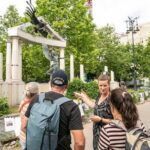

A 4-hour plan that mixes walking, interiors, and smart pauses
This is a short tour in the best sense: enough time to see multiple landmarks, not so long that your feet revolt. Expect a rhythm of walk-and-look stretches plus short, focused stops.
A typical flow goes like this:
- Start at a signature Art Nouveau landmark where you can explore exterior features and also go inside.
- Then move to specific buildings tied to Secession—passages, academies, and major streets.
- Finish with a final cluster of architectural sites, including one stop that’s limited to the facade because of renovation.
The tour includes coffee and/or tea, which matters more than it sounds. In a 4-hour window, that break keeps you sharp for the next interior stop instead of drifting into museum-brain fog.
Timing is also intentionally compact: several stops are around 15 minutes, and a couple are closer to 30. That keeps the day moving, but it means you’ll need to pay attention—if you want longer time inside one building, ask your guide early and they can sometimes adjust the order.
The first iconic stop: where Art Nouveau’s “big idea” shows up
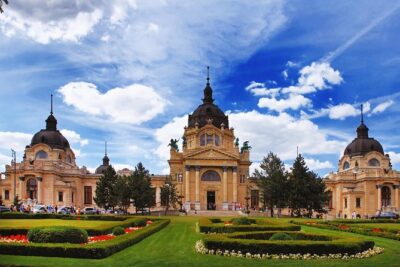
The opening anchor is an iconic Art Nouveau landmark in Budapest, designed to showcase both the lush exterior and interior details. This is a key setup stop. It teaches you how to read the language of the style before you start hunting details street-by-street.
What to expect:
- Exterior time for the recognizably Art Nouveau features.
- Interior time where you can see how those design ideas translate indoors.
- Guide-led explanation that frames what you’re seeing (not just naming parts).
Why it’s worth doing early: if you start this tour by only looking at the street, the style can feel like decoration. Start with an interior and the details start to make sense—shapes, materials, and motifs become part of the building’s identity.
A practical note: since you’re walking and visiting interiors, wearing smart casual shoes helps. Dress is smart casual, and the tour runs in all weather, so plan for rain or cold with layers.
Parisian Passage Café: coffee, passages, and the feeling of design
One of the tour’s most memorable moments is the Parisian Passage Café. This stop is listed with free admission and a focused half-hour slot for the passage and interior.
It’s recently renovated, and the description hints at the kind of place that makes you slow down—an Art Nouveau passage with character strong enough that it almost changes how you walk through it. The best part is that the guide treats the café setting as architecture, not just a break.
What you’ll likely notice:
- The passage layout and how it shapes the experience.
- Decorative details that you can compare to later Secession buildings.
- How interior design reinforces the style’s mood.
For your day: if you’re even mildly interested in design, this is the stop where the tour stops feeling like a checklist. It becomes a sensory lesson in how people lived with architecture, not just how buildings looked.
Liszt Academy: mosaics, mosaics, mosaics (plus national pride)
Next comes the Liszt Academy. It’s described as a homage to Hungarian music and a major example of the international secession style. You’ll get a short 15-minute visit inside the hall, with free entry listed.
This is a good stop if you want the tour to connect art styles to culture. Music matters here. The academy isn’t just an impressive shell—it’s presented as a stage where visual design supports the idea of Hungarian creativity.
What to expect in that brief window:
- Interior highlights such as mosaics and other details.
- A guide’s explanation that ties the look to the broader design movement.
Why only 15 minutes works: if you had an hour, you might forget the point. In 15 minutes, you tend to capture the key visuals and move on with context.





Váci Street fashion palaces: learning to spot Secession on the go
Budapest’s Váci Street is the kind of place where you can accidentally speed past impressive buildings. This tour turns that into a learning street. You’ll spend about 30 minutes walking it and stopping at various urban palaces tied to Art Nouveau heritage, with free admission listed for the stops along the way.
Think of this as pattern recognition practice. Once you know what to look for—ornament styles, window rhythms, entrance design, and how facades handle detail—you start seeing Secession everywhere. The guide helps you connect what you see to the movement’s logic.
Two practical tips for this part:
- Keep your eyes up as much as you can. The interesting stuff often isn’t at knee height.
- If you want photos, tell the guide early where you want to stand—some facades require a certain angle to make the details pop.
Torok-Bankhaz and Postatakarek: the transition from Art Nouveau to Art Deco
This is one of the tour’s smarter moves: it doesn’t freeze time at one style. The Torok-Bankhaz Building helps explain the transition between Art Nouveau and Art Deco. You’ll have about 15 minutes here, with free admission listed.
Then the route goes to the Postatakarek Bank, another 15-minute stop focused on the Hungarian National branch of Secession and its castle-like details. Lechner’s influence is specifically referenced in the tour notes, which is useful because it gives you a “name to attach to what you’re seeing.”
What to expect:
- A side-by-side feeling of how design language changes as you move through periods.
- Details you can compare: ornament that shifts, materials and forms that evolve.
Why this matters for you: if you’re visiting Budapest mainly for architecture, understanding transitions makes your trip feel deeper. Otherwise, you just collect pretty photos without a real “why.”
House of Hungarian Art Nouveau: Secession through a national lens
The House of Hungarian Art Nouveau is dedicated to Secession in Hungarian architecture and is framed around the Hungarian National Style and its influences. Another short 15-minute stop, with free entry listed.
This is a great place to pause and let the tour’s earlier concepts settle. After seeing street examples and institutional buildings, you’re ready for something that’s explicitly about the period’s identity and inspiration.
What you’ll get in that time:
- A focused look at the Hungarian Secession approach.
- A sense of influences and how they show up in design choices.
If you’re the type who loves details, this stop can feel rewarding because it’s not only about “look at this building.” It’s also about “this is what this style meant.”
Zoo-area architecture and the Museum of Applied Arts facade stop
The tour also includes some of the Budapest Zoo buildings, presented as a journey through diversity in Art Nouveau and Secession architecture. The idea here is variety: the style doesn’t behave the same way everywhere, and you get to see that in the urban mix.
Then there’s a final visit at the Museum of Applied Arts. Here’s a key detail: because it’s still under renovation, you can only explore the facade. It’s listed as a 15-minute stop with free entry, but the experience is intentionally limited to what you can safely see right now.
How to treat this stop:
- Use it as a “read the building from outside” moment.
- Notice how the facade still carries the stylistic fingerprints even when interiors aren’t accessible.
I like ending this way because it gives closure: you’ve built your ability to recognize the style by now, so the facade becomes part of your final “aha.”
Price, private group value, and how to gauge $243.53 worth it
At $243.53 per group (up to 15), the pricing is structured for real group economics. If you travel as a pair, it’s not a cheap per-person splurge. If you fill the group with friends (or family), it becomes a bargain compared to paying for multiple individual guides.
Here’s a quick reality check:
- If it’s just 2 people: you’re effectively paying the full group price, so you want to make sure the guide time and interior access are exactly what you want.
- If it’s 4 people: it’s more reasonable.
- If you can get closer to the maximum group size, it’s one of the best ways to get a private, architecture-focused experience.
The tour includes hotel/port pickup and drop-off, a professional Art Historian guide, and coffee and/or tea. Those add real value in a short 4-hour day—especially pickup, because the itinerary is dense and you don’t want to lose time fighting transit.
So the real question isn’t “is $243.53 low?” It’s: do you want a guide who can explain why Budapest Secession looks the way it does, with interior time and a coffee break that fits the theme? If yes, the value is strong.
Logistics that matter: pickup, weather, and not getting turned around
This tour offers hotel/port pickup and drop-off, and your meeting spot is based on where you request pickup. You’ll receive a confirmation within 48 hours of booking (subject to availability), and you’ll use a mobile ticket.
It operates in all weather conditions. That means you should dress for the elements. Bring layers, and if rain is likely, have a small umbrella or a rain jacket you’ll actually wear. You’ll be walking between stops, and the style details are easier to enjoy when you’re comfortable.
One more practical point: in at least one past experience, the meeting process didn’t match expectations and nearly caused a missed start. Your move is simple: confirm pickup details and keep a reliable phone method handy for the day of the tour. That tiny step saves stress.
Who should book this Art Nouveau Private Tour
This tour fits best if you:
- Want a private guide who can translate architecture into understandable stories.
- Prefer a short schedule with multiple landmarks rather than one building with hours of wandering.
- Like coffee breaks that actually relate to the theme.
- Are traveling with friends who might split the group cost.
It may be less ideal if you:
- Need a strictly rigid timetable with zero flexibility. Because it’s private, guides may adjust pacing to your group’s energy and access.
- Expect every stop to be a full interior visit. One major finale is facade-only due to renovation.
Should you book Private Art Nouveau Tour Budapest?
I’d book it if you want Budapest architecture that actually connects to meaning—Hungarian Secession, how it differs, and how it changes over time. The mix of interior access, free-entry stops, smart pickup logistics, and a coffee stop inside an Art Nouveau passage makes this a strong 4-hour investment.
Skip it only if your interests are purely casual (meaning you just want scenic streets, not explanations) or if you’re the kind of traveler who becomes anxious when plans shift slightly. For anyone who loves design, though, this is exactly the kind of tour that turns looking into understanding.
FAQ
How long is the Private Art Nouveau Tour Budapest?
It runs about 4 hours.
What is the group size for this private tour?
It’s a private tour for your group, with the tour priced per group up to 15 people.
Is hotel or port pickup included?
Yes. Hotel/port pickup and drop-off are included, and the pickup is arranged for the ports or hotels you specify.
What language is the tour offered in?
The tour is offered in English.
Is the tour ticket digital?
Yes. You’ll use a mobile ticket.
Is coffee included?
Yes. Coffee and/or tea are included.
Do I need to pay for admission tickets at the stops?
The stops listed for the tour are marked as admission ticket free.
Are public transportation tickets included?
No. Public transportation tickets are not included.
Does the tour run in bad weather?
Yes. It operates in all weather conditions, so dress appropriately.
Can I cancel for a full refund?
Yes. There is free cancellation, and you can cancel up to 24 hours in advance for a full refund.
Are service animals allowed?
Yes, service animals are allowed.