Street art in Budapest is more than wall-doodles. I love the small group feel and the way ET turns each mural, sticker, and sculpture into a real story you can read. The only catch is simple: you’ll do a fair bit of walking on narrow streets, so plan comfy shoes and a slow pace.
You’ll start at Telep-Art GalériaBudapest and finish at Szimpla Kert, one of the city’s most recognizable ruinbar spots. Along the way, you’ll look longer than most people do, and you’ll leave knowing how to spot the political and social messages that street art carries in this part of town.
In This Review
- Key Highlights You’ll Feel Right Away
- A 2-Hour Walk Through Budapest’s Street Art Messages
- Starting at Telep-Art Galéria: Getting Your Eyes Ready
- Narrow Streets, Slow Stops: What You’ll See Along the Way
- District VII From a Local Angle: Why the Neighborhood Choice Matters
- Ending at Szimpla Kert: A Classic Finish with Real Atmosphere
- Price and Logistics: Is $36.20 Good Value?
- Who This Tour Fits Best (And Who Might Skip It)
- Should You Book This Budapest Street Art Walk?
- FAQ
- How long is the street art tour in Budapest?
- What’s the group size limit?
- What language is the tour offered in?
- Where does the tour start?
- Where does the tour end?
- Is there a mobile ticket?
- Can I bring a service animal?
- What if I need to cancel?
Key Highlights You’ll Feel Right Away
- Capped at 8 people, so you get time to ask questions and actually connect the dots
- Guide ET leads the walk, sharing meaning behind murals, stickers, and other styles
- You slow down on thin side streets, where the best work is often easy to miss
- You see street art across formats, including sticker culture and large wall pieces
- Small-group conversation and resources, including recommendations you can keep using after the tour
A 2-Hour Walk Through Budapest’s Street Art Messages
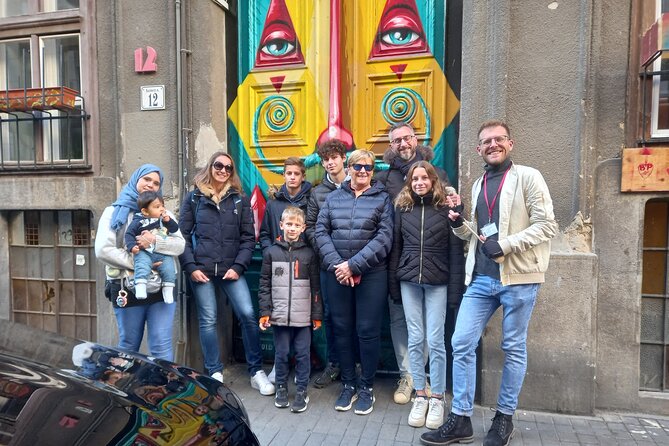
This is the kind of tour that changes how you look at a city. Budapest’s street art isn’t just decoration. It’s commentary, branding, protest, humor, and sometimes a coded message for people paying attention.
What makes this experience different is the focus on meaning. You’re not just getting a list of cool-looking walls. You’re learning how to interpret what’s being said, and why it lands the way it does. That matters, because street art can look random until someone gives you the frame to read it.
I also like the pace. The walk is described as slow, on thin streets, which is exactly how street art gets appreciated. You stop often, you notice details, and you don’t feel rushed. And since it’s capped at eight travelers, you’re more likely to hear every explanation instead of watching it happen from a distance.
One thing to consider: this is a walking tour, and it’s not focused on big landmark photos. If you want a single grand view at every stop, you might find this tour more thoughtful than sightseeing-heavy.
You can also read our reviews of more tours and experiences in Budapest



Starting at Telep-Art Galéria: Getting Your Eyes Ready
The tour begins at Telep-Art GalériaBudapest, Madách Imre út 8, 1075 Hungary. Starting at a gallery makes a smart kind of sense. Even if you normally skip galleries, it sets the mental mode: street art here is treated like part of the urban conversation, not just random paint.
From the start, the emphasis is on learning the language of what you’re seeing. ET doesn’t just point at art and move on. He guides you through what the piece is doing—socially, politically, and emotionally.
This opening is also helpful for first-time visitors to Budapest. One review notes that it’s a great first-day activity because it gives you a way to read the city immediately. You’re essentially getting a pair of interpretive glasses that you can keep wearing as you wander on your own.
Practical note: the tour is offered in English and uses a mobile ticket, so you’re not scrambling for paper in the meeting area.
Narrow Streets, Slow Stops: What You’ll See Along the Way
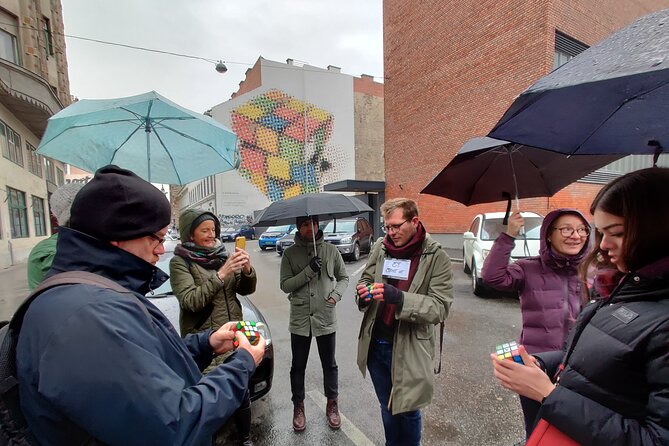
The heart of this experience is the walking. You’ll move through the thin streets at an unhurried pace, and ET shows you many pieces as you go. The goal is simple: you learn to spot street art on your own, even the small work that blends into a wall until you know what to look for.
Based on the descriptions of what happens on tour, you can expect a mix of styles, not just painted murals. One participant specifically mentioned seeing bronze sculptures, stickers, smart-art images, and large-scale wall paintings. That variety is a key part of why this tour works: it shows that street art isn’t one format. It’s a practice.
You’ll also hear explanations for the messages behind the works. Some of the best moments come when you realize street art in District VII is often shaped by local history and politics. Street art here becomes a kind of public debate, using symbols, style, and placement to talk back to the world.
A detail I found particularly appealing from the overall tone: the tour is described as not black and white. ET discusses what’s happening and why, and the art is treated as part of a living conversation rather than a fixed museum label. That framing matters if you like art that raises questions more than art that just pleases.
One more thing: it sounds like ET adapts how he guides depending on the group. Reviews mention that he varies the tour and tailors it, especially on days when attendance is lighter. So even if you’re thinking of doing something similar on another day, this one doesn’t feel like a copy-paste route.
District VII From a Local Angle: Why the Neighborhood Choice Matters
This walk focuses on District VII, and that neighborhood factor is part of the value. District VII has a different energy than the postcard core, and the tour is built to help you understand that difference on foot.
There’s also a strong practical benefit to doing a neighborhood tour like this early. If you’ve got two or three days in Budapest, you can use this to learn your way around the human scale of the area. You start noticing how streets connect, where people gather, and what the visual culture looks like outside the usual tourist sweep.
Several reviews point out that you’ll see street art that tourists miss, including small sticker culture and hidden messages. That’s exactly what you want from this type of tour. If the guide only showed obvious, heavily photographed murals, you’d learn less and you’d feel less hooked after the tour.
Instead, you’re trained to look at the edges: the corner pieces, the smaller placements, and the work you’d normally walk past because it doesn’t scream for attention. After that, it becomes hard to stop noticing art everywhere.
The tour is also described as interactive. You’ll have a chance to ask questions, and the group conversation can add extra context, especially if the people in your group have different backgrounds in art or just different interests.
Ending at Szimpla Kert: A Classic Finish with Real Atmosphere
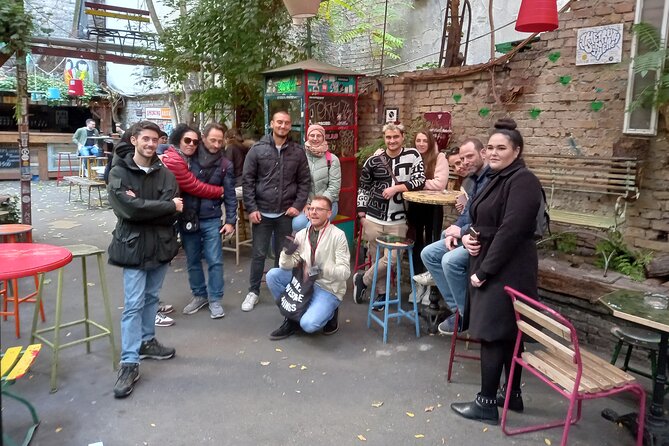
The tour ends at Szimpla Kert, Kazinczy u. 14, 1075 Hungary. This isn’t just a random drop-off point. Szimpla Kert is described as the oldest ruinbar in Budapest and a symbol of the city, so it’s a fitting final stop for a tour about underground and alternative culture.
Why this finish works: it gives you a place to decompress right after the walk. You’ve spent two hours training your eyes and your brain to interpret street messages. Then you can step into a setting that matches that theme—creative, alternative, and very Budapest.
Even if you don’t go inside right away, the timing is good. You end near a well-known hub, which makes it easier to continue your day on foot or by public transport. The tour is noted as being near public transportation, which helps if you don’t want to plan your schedule around getting back to your hotel.






Price and Logistics: Is $36.20 Good Value?
The price is $36.20 per person for an approximate 2-hour guided walk, with English and a group size capped at 8. On its face, it’s not a budget tour. But the value comes from what you get for that money.
You’re paying for three things that are hard to DIY:
- Interpretation: learning the meaning behind murals, stickers, and other formats.
- Focus: a route designed for slow looking, not just fast sightseeing.
- Access to a local communicator: ET shares background and political/social context so you understand what you’re seeing.
The small group size matters here. In a bigger group, you usually spend the tour half-listening and half-trying to see over other heads. With eight people, it feels more like a guided walk with a knowledgeable host and time for questions.
Also, you’ll notice the reviews lean hard into the idea that the guide points out art tourists would miss. That’s a big part of why this feels worth it: you’re buying someone’s ability to slow you down and show you where to look.
If you’re the type who loves art but hates wasting time, this is a strong pick. If you’re strictly chasing major monuments and you don’t care about interpretation, you may feel like it’s too niche.
One planning consideration: the experience is described as being booked about 25 days in advance on average. That suggests it isn’t something you should treat like a last-minute impulse unless you’re flexible.
Who This Tour Fits Best (And Who Might Skip It)
I’d put this tour high on your list if you like:
- Alternative culture and want to see Budapest through a different lens
- Art with political or social messaging
- Walking tours where you stop often and actually look
- A guide who shares context and answers questions (ET’s energy shows up again and again)
It also sounds like a good choice for mixed ages. One review explicitly mentions it being good for families, and the overall tone suggests it’s not a stuffy lecture. You’ll be walking and talking, not sitting in one place.
If you might want to skip it, it’s usually because of one thing: the tour is mostly about art meaning and messages, not landmark checklists. If you only have a little time and you want the most famous sights packed into that time, this won’t do that job.
Also, it’s not described as a rapid sprint. It’s slower. That’s great for most people, but if you’re trying to cover every hour with high-intensity sightseeing, you might feel it’s too calm.
Should You Book This Budapest Street Art Walk?
Yes, if you want Budapest to feel personal fast. This tour helps you understand the city’s alternative side, and more importantly, it teaches you how to read street art so you keep seeing it after the tour ends.
Book it if you:
- like small-group walking with real conversation
- enjoy art that talks about the world, not just art that decorates walls
- want a guide who gives context, not just locations
You might skip it if:
- you dislike walking or narrow streets
- you only want classic tourist highlights
- you’re not interested in symbolism, politics, or social meaning
If you do book it, go with an eye-for-details mindset. Bring comfy shoes. And be ready to look at walls like they’re speaking.
FAQ
How long is the street art tour in Budapest?
It’s about 2 hours.
What’s the group size limit?
The tour has a maximum of 8 people.
What language is the tour offered in?
It’s offered in English.
Where does the tour start?
The meeting point is Telep-Art GalériaBudapest, Madách Imre út 8, 1075 Hungary.
Where does the tour end?
It ends at Szimpla Kert, Kazinczy u. 14, 1075 Hungary.
Is there a mobile ticket?
Yes, it uses a mobile ticket.
Can I bring a service animal?
Service animals are allowed.
What if I need to cancel?
You can cancel for free up to 24 hours in advance for a full refund. If you cancel less than 24 hours before the start time, the amount paid won’t be refunded.