REVIEW · BUDAPEST
Born Under The Red Star – Communist tour with Coffee in a Retro Bar
Book on Viator →Operated by Budapest Urban Walks · Bookable on Viator
Political Budapest gets real fast.
This 3-hour Communist walking tour connects the dots between monuments, museums, and the city streets you’ll otherwise sprint past. I like the way the guide gives clear, on-foot context, and I also appreciate the small payoff at the end: a classic soda in a Communist-themed retro bar with coffee or tea to keep you going.
One thing to plan for: the subject matter is heavy. If you prefer light, photo-only sightseeing, you may find the stop at House of Terror emotionally intense.
In This Review
- Key things you’ll notice on this walk
- Budapest’s Red Star story, told in 3 hours
- From the Hungarian State Opera to Liberty Square: the route idea
- Stop 1: The Soviet Heroic Memorial and what it signals
- Stop 2: House of Terror on Andrássy út 60
- Stop 3: St. Stephen’s Basilica and the reliquary detail
- The Freedom Statue on Gellért Hill: independence in metal
- Stop 4: Szabadság tér and its two controversial memorials
- The 1956 memorial: when resistance became Hungary’s headline
- Hungarian Parliament Building: state power, up close
- The retro bar pause: classic soda and coffee/tea
- Value for your money: is $90.31 worth it?
- Weather, timing, and how to prepare
- Who this tour is best for
- Should you book Born Under The Red Star?
- FAQ
- Where does the tour start and end?
- How long is the tour?
- Is it offered in English?
- What’s included in the price besides the tour?
- Are museum or church tickets included?
- How big is the group?
Key things you’ll notice on this walk
- Small group (up to 15) keeps the pace human and the questions easier.
- Frequent stops with meaning help you connect memorials to real events, not just dates.
- House of Terror on Andrássy út 60 puts political violence in the same spotlight as other regime victims.
- Liberty Square’s two controversial memorials give you a built-in lesson on how memory works in Budapest.
- Retro bar break with a classic soda plus coffee/tea is a fun palate reset after the museum.
- Maps and recommendations mean you leave with a short list for independent exploring.
Budapest’s Red Star story, told in 3 hours
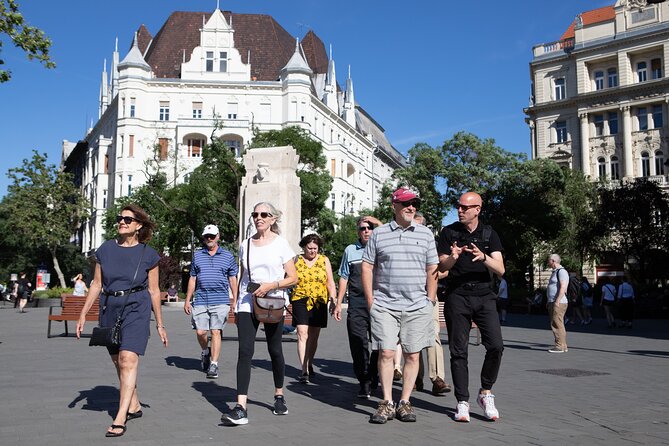
Budapest can feel like three cities stacked on top of each other: grand sights, thermal-city vibes, and the politics that shaped daily life. This tour takes the political thread and walks it through the places you’ll pass at street level.
I like that the format is tight. You get multiple stops with quick time-on-site blocks, so you’re not stuck in one place too long. And because you end at Liberty Square, you finish right where you can keep wandering on your own.
You’ll also get a practical kind of history. Instead of abstract lectures, the guide points out what each site is commemorating and why it still matters when you’re standing in the open air.
You can also read our reviews of more drinking tours in Budapest



From the Hungarian State Opera to Liberty Square: the route idea
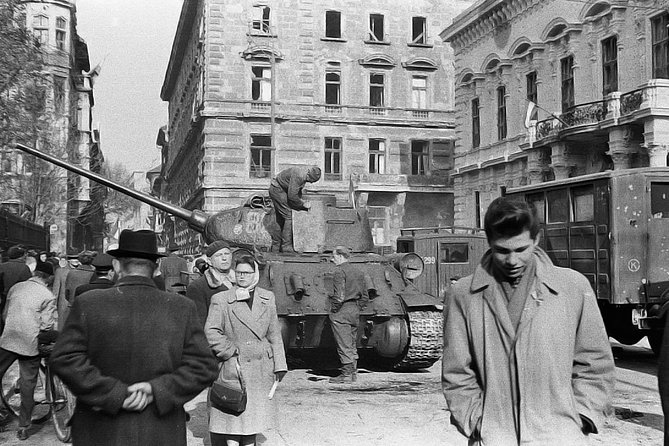
You start at the Hungarian State Opera on Andrássy út (Andrássy út 22). That’s a smart starting point because it puts you on one of Budapest’s big, straight arteries before you begin turning your attention toward memory, power, and resistance.
You finish at Liberty Square (Szabadság tér), which is both a landmark and a junction. This matters because the tour doesn’t end with the guide handing you off into nowhere. From Liberty Square, you can branch out to nearby sights and cafés without needing to plan a whole separate trip.
The group size cap of 15 helps here. Streets and sidewalks can get crowded, and you’ll be walking as a compact unit instead of a long line that squeezes into everything.
Stop 1: The Soviet Heroic Memorial and what it signals
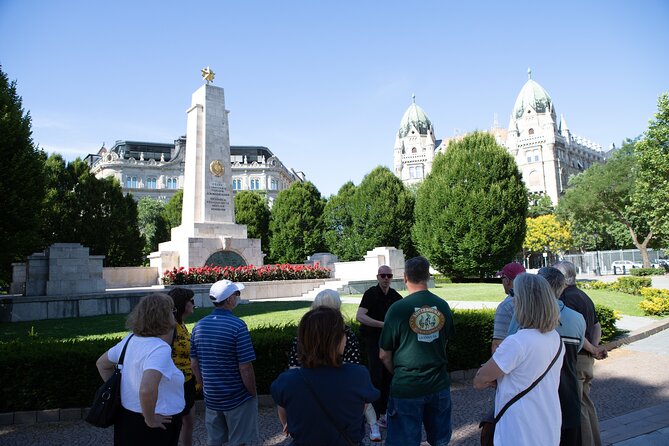
Your first stop is the Soviet Heroic Memorial, a white obelisk in a park setting that commemorates Russian military who served in WWII. Even if you already know the broad story of WWII in Central Europe, I like how starting with a WWII-era monument reframes what comes later in the tour.
In just about 15 minutes, you’re not trying to read every plaque detail. You’re getting the anchor point: a visual symbol of Soviet presence and sacrifice, placed in a public park where it can shape what people associate with liberation and authority.
If you’re the type who likes to photograph first and ask questions later, this is still workable. The obelisk is bold and easy to frame, and the guide commentary gives you something to look for beyond the obvious.
Stop 2: House of Terror on Andrássy út 60
Next is the real emotional pivot: House of Terror Museum at Andrássy út 60. This is where the tour turns from monuments to the documented reality of political regimes in 20th-century Hungary.
The museum focuses on exhibits related to fascist and communist regimes, and it also serves as a memorial to victims who were detained, interrogated, tortured, or killed in the building. That wording is blunt by design, and the experience can feel morally heavy even when you’re only there for around 15 minutes.
Here’s the value for you: short tours can sometimes feel like they skim. This one doesn’t skip the weight; it puts you at the site where you can’t pretend the era was only about slogans. Even with a brief time block, the context should help you understand why this museum is still central to the conversation about repression in Hungary.
A consideration: if you’re sensitive to accounts of torture or imprisonment, you may want to pace yourself. You can also take a step back and let the guide’s explanation do the heavy lifting at first, before you start reading exhibit text at your own speed.
Stop 3: St. Stephen’s Basilica and the reliquary detail
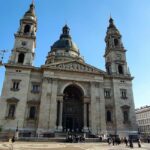
After the museum, the tour shifts gears to St. Stephen’s Basilica (Szent István Bazilika). You’ll have about 15 minutes here, and while admission isn’t included, the site is a major Budapest moment worth seeing even if you’re not a hardcore church-goer.
I like this stop because it’s not “just a pretty building.” The basilica is named for Stephen, the first King of Hungary, and the tour highlights a specific feature: his right hand is housed in a reliquary.
So you get a different kind of power symbol. If the communist era is remembered through terror and political control, the basilica represents a longer timeline of national identity tied to monarchy and religious tradition.
Practical note for your planning: since admission is not included, you may choose how much you want to spend inside versus how much time you prefer for the outside views and immediate surroundings.
You can also read our reviews of more tours and experiences in Budapest

The Freedom Statue on Gellért Hill: independence in metal
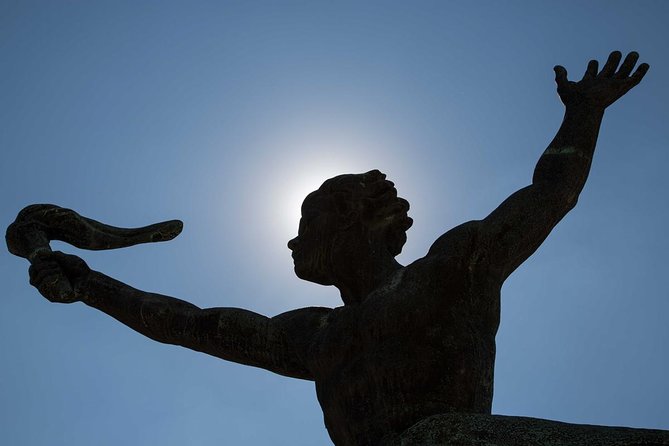
Then the tour brings you to the Liberty Statue, also called the Freedom Statue (Szabadság-szobor) on Gellért Hill. This monument commemorates those who sacrificed their lives for Hungary’s independence, freedom, and prosperity.
I appreciate including this kind of stop because it gives your eyes a break from the museum’s interior-focused weight. It’s still political, but it’s expressed through commemoration rather than documentation.
Also, this helps you understand that Hungarian memory isn’t only about one side or one era. In a short walk, you’ll see multiple layers: Soviet WWII-era presence, regime terror, national religious identity, and then the specific idea of independence and freedom.
If you plan to take photos, this is a good place to slow down. Monuments on hills often reward a step away from the main path so you can catch different angles of the statue against the city.
Stop 4: Szabadság tér and its two controversial memorials
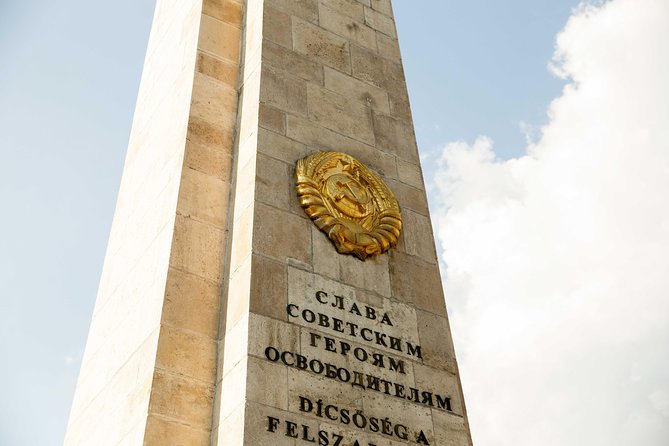
Now you arrive at Liberty Square (Szabadság tér), and it’s famous for two memorials with obvious controversy. This stop is a masterclass in how a place can be both public space and political argument.
One memorial commemorates Hungarian Jewish victims of the Holocaust. The other commemorates Soviet soldiers who liberated Budapest from the Nazis in 1945. The guide’s commentary is the key here—standing in the square without context can make the symbolism feel like it’s floating in the air.
In about 15 minutes, you’ll also take in the surrounding landmarks: the United States Embassy and the historicist-style headquarters of the Hungarian National Bank on the west side of the square.
For you, this stop works because it’s not only about the past. It shows how modern Budapest still sits right next to its contested history, and how major institutions share the same public stage.
A small consideration: because this is a major open square, you may get distracted by people and traffic. You’ll get more from the stop if you focus on what the guide points out and let the square be a backdrop rather than a distraction.
The 1956 memorial: when resistance became Hungary’s headline
Next is the Memorial to the 1956 Hungarian Revolution and War of Independence, which commemorates heroes of the 1956 uprising against the communist regime. This is one of the stops that ties everything together, because it reframes what “communist rule” meant on the ground.
Even in a 15-minute visit, the point lands. The tour isn’t only describing oppression as a concept. It highlights rebellion and independence as a direct counterweight.
I like that the tour keeps moving after this stop. It doesn’t let you get stuck in one emotion. Instead, it uses 1956 as your bridge into the final major civic landmark.
Hungarian Parliament Building: state power, up close
Your final major landmark is the Hungarian Parliament Building (Országház), a seat of the National Assembly of Hungary. Admission isn’t included, but you’re still meant to see it as the grand civic end point of the walk.
This matters because it contrasts the tour’s earlier themes. You start with a Soviet WWII memorial, see a museum about fascist and communist regimes, and then you land at the building that represents the modern state. The guide commentary should help you keep the timeline straight.
Even if you don’t go inside, the exterior presence is enough to make the point: the built environment in Budapest is political whether it’s trying to be or not.
The retro bar pause: classic soda and coffee/tea
The name of the tour matters because the tour includes a break. You’ll stop for a classic soda in a Communist-themed retro bar, and you’ll also get coffee and/or tea.
I love these small, included pauses on history walks. It keeps your brain from overheating after the heavier stops. It also gives you a more human end to the story, with decor that matches the theme so the mood stays consistent.
This part also works for value. Tours that deal with political sites often feel like they take everything from you—time, attention, emotional energy. Here you get a small, concrete treat included in the price.
Value for your money: is $90.31 worth it?
At $90.31 per person for about 3 hours, you’re not buying a museum day or a food-and-drink crawl. You’re buying interpretation—time with a guide, a guided sequence of major sites, and included drinks.
For me, the value check is simple:
- If you like walking and you want the city explained as you go, the format fits.
- If you would otherwise visit only one or two of these sites on your own, the guided route can save you the work of piecing together context.
Also, the small group size of up to 15 matters. You’re more likely to get a guide who can answer real questions than a big-bus chaos setup.
And because maps and further recommendations are included, you’re not just paying for three hours of walking. You’re buying a plan for what to do after you reach Liberty Square.
Weather, timing, and how to prepare
This tour runs when the weather is workable. If it’s canceled due to poor weather, you’ll be offered a different date or a full refund.
For preparation, keep it basic:
- Wear comfortable shoes for walking between monuments.
- Dress for Budapest weather and bring a light layer if you’re sensitive to wind around squares and hills.
- If you want to spend extra time at a site like St. Stephen’s Basilica, plan to do it independently since admission there isn’t included.
One more practical point: it’s offered in English, and you’ll receive a confirmation at booking. If you prefer a mobile ticket, this tour supports that too.
Who this tour is best for
This works especially well if you:
- Want a structured way to see Budapest’s 20th-century political sites without guessing what you’re looking at.
- Like guide commentary that helps you interpret monuments and museums.
- Want a short, focused day activity with a clear start at the State Opera and an ending at Liberty Square.
It might be less ideal if you’re:
- Looking for a relaxed, entertainment-first city stroll.
- Trying to avoid intense themes related to political imprisonment or torture.
Should you book Born Under The Red Star?
If your goal is to understand Budapest beyond the postcard layer, I’d book it. The combination of major sites, tight timing, and a guide who connects the dots is exactly the kind of value that makes a short tour feel like more than the sum of its stops.
I’d only hesitate if you strongly prefer upbeat, low-emotion sightseeing. The museum stop and the memorial focus will not feel light. But if you can handle serious subject matter, this tour gives you a grounded way to see why these places look the way they do—and why locals still care.
FAQ
Where does the tour start and end?
The tour starts at the Hungarian State Opera on Andrássy út 22, Budapest, and it ends at Liberty Square (Szabadság tér), Budapest.
How long is the tour?
The tour lasts about 3 hours.
Is it offered in English?
Yes, the tour is offered in English.
What’s included in the price besides the tour?
The tour includes a classic soda in a Communist-themed bar, coffee and/or tea, plus maps and further recommendations.
Are museum or church tickets included?
Admission is free for the Soviet Heroic Memorial, House of Terror, and the memorials at Liberty Square and for the 1956 Revolution. Admission for St. Stephen’s Basilica is not included, and the Hungarian Parliament Building is also not included.
How big is the group?
The tour has a maximum of 15 travelers. Children must be accompanied by an adult, and service animals are allowed.