REVIEW · BUDAPEST
Lives of Hungarians Under Communist and Capitalist system
Book on Viator →Operated by Triptobudapest.hu - Free Budapest Walking Tours · Bookable on Viator
Communism can feel personal fast in Budapest. This small-group tour uses real-life stories and street-level details to explain how Hungarian life changed under communism and after. What makes it compelling is the guide’s lived perspective and the way the route links big events to everyday stuff you can still point at.
I especially like the stop-by-stop storytelling—travel documents, car types, religious life in real neighborhoods, and the way people talk about the past now. I also like that you get a tight, interactive history lesson early on, so the rest of the walk makes more sense as you go.
One consideration: this is only about 1.5 hours, so if you want a long, academic lecture, you may feel you need more time (and more reading) after the tour. Also, some themes are heavy, even though the guide keeps it understandable.
In This Review
- Key highlights you should care about
- First meeting: Budapest Eye and a communism warm-up that actually helps
- Fröccsterasz: how people traveled when movement was controlled
- St. Stephen’s Basilica: religion under communism wasn’t one-size-fits-all
- District V (inner city): housing, education, media, and why nostalgia persists
- Szabadság tér: nuclear bunker exits, guarded buildings, and street art
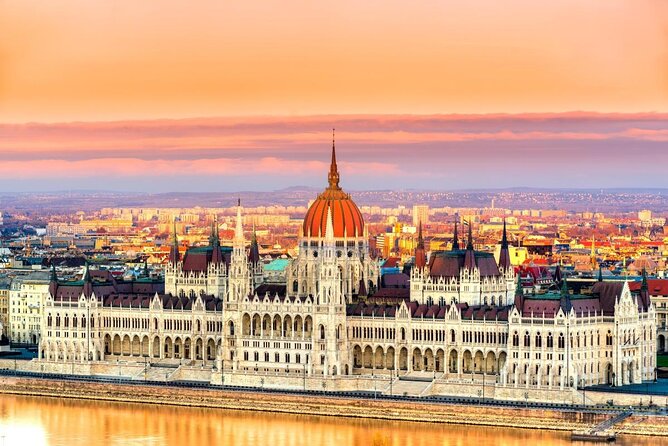
- Parliament area: 1956, bullet holes, and what revolution feels like from childhood
- Price and value: the low base cost plus the real-world tip culture
- Timing, group size, and ticket style (so you don’t waste time)
- What kind of traveler should book this?
- Should you book?
- FAQ
- Where does the tour start and end?
- How long is the tour?
- What’s the group size?
- What’s included in the price?
- Do I need tickets for sights during the tour?
- Will I need to tip the guide?
- What’s the cancellation window?
Key highlights you should care about
- A guide with firsthand perspective on communism and its aftermath, not just textbook history
- Interactive communism primer right at the start, built for people who are new to Hungarian history
- Street-level details like travel documents, communist-era transport, and visible traces around the Parliament area
- Religion, housing, media, and education explained through neighborhood realities, not generic talking points
- The 1956 uprising focus, including bullet-hole details you can physically see
- Short walking route through central Budapest, with frequent context at each stop
First meeting: Budapest Eye and a communism warm-up that actually helps
The tour kicks off at the Budapest Eye area (you’ll meet within about 20 meters of the ferris wheel). This is a smart start point because it’s easy to find, and it gets you oriented in central Budapest right away.
Before the route really expands, your fully licensed guide gives a 15-minute interactive history lesson on Hungarian and Central European communism. That matters more than it sounds. Instead of starting with dates and leaders, the guide sets the mental framework: how the system shaped daily life, how people navigated it, and why the post-communist years didn’t automatically erase all of that.
You’ll also get a sense of tone early on. The tour promises a balanced view—how communism worked in practice for ordinary people, and how attitudes shifted after. It’s not just propaganda history on repeat. It’s history you can connect to the present.
If you like tours that help you read a city, this opener will click. If you hate listening early and prefer to jump straight to sights, give it a few minutes—this part is built to make the rest easier.
You can also read our reviews of more tours and experiences in Budapest.
Fröccsterasz: how people traveled when movement was controlled
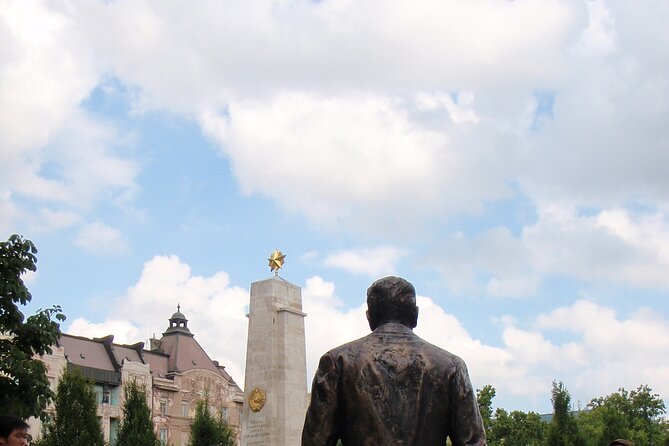
One stop takes you to Fröccsterasz, where the guide focuses on the realities of incoming and outgoing travel from Hungary. You’ll look at basic travel documents and hear stories about movement across borders—what was possible, what wasn’t, and how everyday people experienced that friction.
This is one of the best-value parts of the tour because it turns a big idea—control—into something concrete. Instead of just saying the system restricted people, you’re shown what that meant on paper and in daily life.
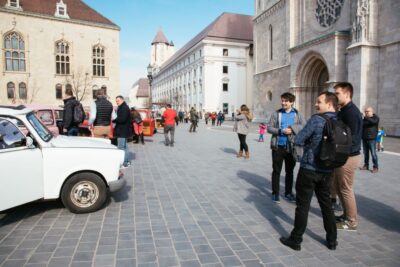
You’ll also learn about communist-era car types and transportation, which is a nice twist. A lot of history tours ignore infrastructure and everyday mobility. Here, transport becomes a lens for how the system functioned: what people used, what they couldn’t easily get, and how daily routines adjusted.
Time here is brief (about 10 minutes), so you won’t get a full mechanics-history lecture. Still, you’ll leave with a clearer understanding of how travel wasn’t simply about wanting to go somewhere—it was about permissions, documents, and the mood of the system.
St. Stephen’s Basilica: religion under communism wasn’t one-size-fits-all
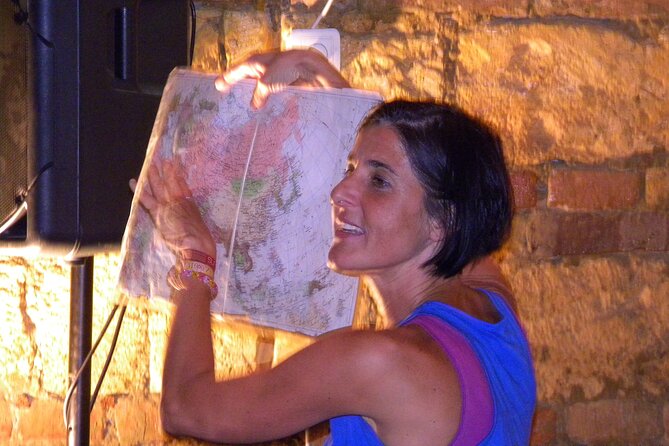
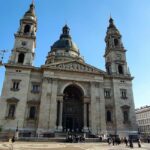
At St. Stephen’s Basilica (Szent Istvan Bazilika), the tour shifts toward how communism affected religious life. You’ll hear about the difficulties different denominations faced during communism, and the guide points out that experience varied family by family.
That detail is key. It prevents the common tourist mistake of treating oppression as the same story everywhere. Even when laws and pressures came from the system, people still experienced them through their households, local communities, and personal choices.
You’ll also see how history shows up in architecture and location. Standing near one of Budapest’s major landmarks, it’s hard not to think about continuity and change—what survived, what adjusted, and what people learned to keep private.
A possible downside: if you’re hoping for a deep dive into specific church-state policies, this segment won’t be that. It’s more like a well-aimed explanation that helps you understand why religion was both visible and risky, depending on who you were and where you lived.
District V (inner city): housing, education, media, and why nostalgia persists
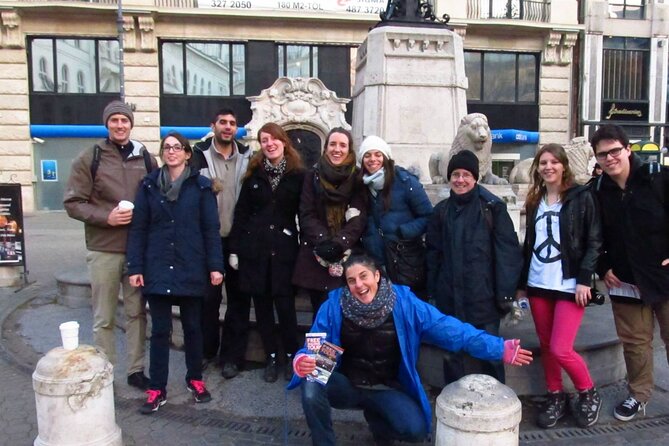
Next comes the District V / Inner City area, where the guide tackles the everyday machinery of communism and the transition afterward. You’ll hear about housing, health care, education, media culture and propaganda, sport, and the Olympic Games.
This portion works because it connects institutions to real daily life. Housing and education aren’t abstract concepts here—they’re part of how the state shaped what you could hope for and how you were expected to behave. Media and propaganda get treated as tools, not just “things people didn’t like.”
You’ll also hear why some people have nostalgia for communism. That topic can be polarizing, but the tour’s promise of balance shows up here. Instead of reducing nostalgia to ignorance or rose-colored glasses, the guide explains why comfort, structure, or certainty can still feel attractive—especially when the post-communist years were uneven.
This is a strong stop for anyone who wants the human layer of history. It’s also a strong stop for parents and teachers—because it gives you language to talk about the “why” behind the system, not only the “what.”
Szabadság tér: nuclear bunker exits, guarded buildings, and street art
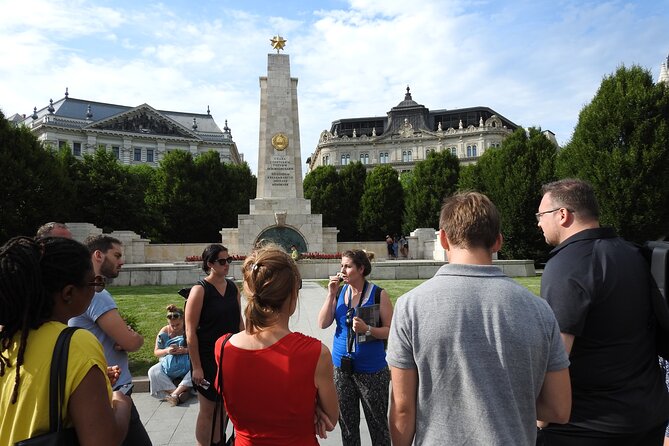
At Szabadság tér, the tour gets visually dramatic. You’ll see both controversial monuments and an emergency exit connected to the F4 military nuclear bunker. Even if you don’t go underground (you don’t), hearing how survival planning looked at street level changes your understanding fast.
You’ll also notice urban art and guerilla-style statues. That’s not random decoration; it’s how people respond when official narratives feel too controlled. Street art becomes a kind of public memory.
Then there’s another detail that’s hard to forget: the second most guarded building, which provided shelter for a prominent Hungarian person for over 15 years. That’s the kind of fact that makes you look twice at what you’re standing near. It turns a familiar square into a place with hidden layers.
One caution here: some stops like this are more about ideas than photos. If your goal is strictly to take pretty pictures, you can still do that, but you’ll get more out of the tour by listening closely and letting the history change how you see the scene.
Time at Szabadság tér is about 10 minutes, so it’s compressed. Think of it as a highlight reel of the era’s paranoia, symbolism, and coping mechanisms.


Parliament area: 1956, bullet holes, and what revolution feels like from childhood
The tour finishes near the Hungarian Parliament Building area at Kossuth Lajos tér. This segment centers on the 1956 uprising in depth, and it’s emotional without becoming sloppy.
You’ll learn about the heroes of 1956 and hear stories connected to experiencing the revolution as a child. The guide also points out bullet holes on the facade of residential buildings around the Parliament—visible reminders that history isn’t only in museums. It’s on buildings you pass every day.
This is the stop that tends to stick with people because it’s physical. A printed story can fade. A visible scar changes your sense of what people went through.
If you’re someone who likes to understand how cities remember trauma, you’ll appreciate the structure here: uprising context, personal perspective, then the visual evidence nearby. It’s not only a history lesson; it’s a lesson in how place shapes memory.
Price and value: the low base cost plus the real-world tip culture
The price listed is $4.65 per person, and the average booking happens about 14 days in advance. That low base price is where you should pay attention to value.
Here’s the practical reality: the booking fee is described as an administrative and marketing fee, and it doesn’t contribute to the guide’s earnings. That means you should budget for tipping your guide at the end. The tour notes that most guests tip around €10 per person, and some tip more.
So the cost is really two parts: a small fee to reserve your spot, then a donation that keeps the guide running the tour. If you’re used to free walking tours, this won’t surprise you. If you’re not, plan ahead so you don’t feel awkward at the end.
For me, the value comes from something specific: you’re paying for (1) a small group experience, (2) live interpretation from someone with firsthand perspective, and (3) a route with concrete, visible details you can’t easily replicate on your own without context.
At the same time, because the tour is about 1 hour 30 minutes, you may wish you had a longer version. It’s a strong introduction, not a substitute for reading or a museum visit.
Timing, group size, and ticket style (so you don’t waste time)
The tour lasts about 1 hour 30 minutes, and it has a maximum of 20 travelers. That small cap is a big deal. You’ll usually get room to ask questions, and the guide can keep the tone personal.
It uses a mobile ticket, and you’ll confirm at booking time. Service animals are allowed, and it’s near public transportation. The meeting point is in central Budapest, and the conclusion is about 50 meters from the M2 red metro line.
You start at 3:30 pm. That late-afternoon timing is convenient: you can still do other sightseeing afterward, and the day heat often feels kinder by then in summer months.
What kind of traveler should book this?
This tour is a great fit if you want more than monuments. You want the stories behind them—housing, education, travel restrictions, media pressure, and the emotional weight of 1956.
It’s also ideal if you’re traveling with teenagers or students, because the guide’s framing is designed to turn school concepts into lived reality. Even if you’re not bringing kids, you’ll likely end up with better conversation material for dinner that night.
If you hate heavy topics or get worn down by political history quickly, you might find it intense. The guide keeps explanations balanced, but the subject matter is real.
And if you want ultra-deep academic treatment, you may prefer a longer specialized program. This one is built for clarity and context in a short time.
Should you book?
Yes—with two conditions.
Book it if you like short, story-driven tours that connect policy to everyday life, and if you’re ready to trade a little comfort and photo time for listening. The 1956 focus, the bullet-hole details, and the way the guide ties communism to post-communism attitudes are worth it.
Don’t book if you want a purely scenic walk or a strictly neutral, museum-style experience with no emotional storytelling. Also, plan your budget for the end tip; the base price doesn’t cover the guide’s work.
If you do book, come with a simple mindset: treat it like an orientation to how Budapest and Hungary remember themselves. You’ll leave seeing more than buildings—you’ll see the system written into the streets.
FAQ
Where does the tour start and end?
The tour starts at the Ferris Wheel of Budapest area, near Budapest Eye (Budapest, Erzsébet tér, 1051 Hungary). It ends at the Hungarian Parliament Building area (Kossuth Lajos tér 1-3, 1055 Hungary), about 50 meters from the M2 red metro line.
How long is the tour?
It runs for about 1 hour 30 minutes.
What’s the group size?
The tour has a maximum of 20 travelers.
What’s included in the price?
The booking fee is included. The info provided also states that this fee is for administration and does not contribute to the guide’s earnings.
Do I need tickets for sights during the tour?
The details list admission ticket pricing as free for the stops mentioned in the tour, and the tour uses a mobile ticket.
Will I need to tip the guide?
Tips are not included. The tour states guides depend entirely on donations at the end, and it suggests €10 per person as most guests’ tipping level.
What’s the cancellation window?
You can cancel for a full refund if you cancel up to 24 hours before the experience’s start time.